Author: caian@ineedsurgery.com

  • Erova Energy and Elgin sign long-term PPAs for 112 MW UK solar portfolio

    Erova Energy and Elgin sign long-term PPAs for 112 MW UK solar portfolio

    London, 21 July, 2026 – Elgin, a fully integrated, utility-scale solar and storage Independent Power Producer (IPP), has signed three 15-year Contracts for Difference (CfD)-backed Power Purchase Agreements (PPAs) with Erova Energy Group (Erova), which will provide route-to-market and asset optimisation services for a 112.6 MW portfolio of UK solar projects.

    The portfolio comprises three projects that secured CfD in the UK’s Allocation Round 6 auction: Thorpe (61.9 MW) in Staffordshire, Aston Flamville (26.2 MW) in Leicestershire and Maes Mawr (24.5 MW) in Glamorgan, Wales. Construction is already underway, across the portfolio, which is expected to power approximately 24,000 homes across the UK.

    Under the 15-year agreements, Erova will provide route-to-market, trading and balancing services for the portfolio, supporting the efficient delivery of renewable electricity to the grid throughout the lifetime of the contracts. Since its acquisition by Macquarie Group in 2025, Erova has expanded its PPA capabilities, including its ability to participate in larger tenders and support longer-term contracts.

    The agreements represent another important step in progressing the portfolio towards operation, following the commencement of construction across the portfolio and a recent financing secured to support the delivery of Elgin’s overall UK pipeline.

    Nick Williams, Chief Executive Officer, Erova said:

    “These agreements highlight Erova’s ability to support larger renewable projects in the UK through flexible, long-term PPA and risk management solutions. As solar generation continues to evolve, effective market optimisation is becoming increasingly important. Our trading platform actively manages negative pricing events while capturing intra-day trading opportunities where available, helping to optimise asset value throughout the life of the projects. We’re pleased to bring this approach to Elgin’s portfolio and support these projects as they move into long-term operation.”

    Dermot Kelleher, Chief Executive Officer, Elgin, said:

    “Establishing a strong route-to-market partnership is fundamental to delivering reliable, low-carbon electricity over the long term. Alongside construction, financing and the CfD awards already secured, these agreements with Erova are another important step as we progress these projects from development into long-term operation. We look forward to working with Erova as these projects are brought online and begin contributing to the UK’s energy transition.”

  • Macquarie announces the acquisition of Erova Energy

    London, 25 July 2025 – Macquarie, through its Commodities and Global Markets group (Macquarie), has reached an agreement to acquire 100 per cent of Erova Energy Group (Erova).

    Erova is a renewable asset optimisation company operating in the UK and Ireland with capabilities across Europe. It services a growing portfolio of wind, solar, waste-to-energy and battery storage assets with power purchase agreements (PPAs), market access, balancing services, as well as providing meter registration services. More recently, Erova expanded into renewable energy supply for industrial and commercial customers in Ireland through Erova Energy Supply, 

    Renewable energy producers rely on companies like Erova to manage price risk, enhance operational efficiency and meet grid requirements. As the world’s renewable energy capacity continues to grow, there is increasing demand for these services to facilitate the energy transition.

    After a decade of sustained growth in the UK and Ireland, Erova has significant potential to scale its platform in existing markets and internationally with the support of Macquarie’s investment and extensive experience in global energy markets.

    Rishil Patel, Senior Managing Director at Macquarie, said: “Erova is uniquely positioned in its ability to offer four key services to clients including PPAs, route to market, balancing services, and energy supply logistics. This is a strategic acquisition for Macquarie that will help unlock barriers to Erova’s growth.”

    Nick Williams, Co-CEO at Erova said: “Given the UK and Irish Governments’ ambitions to have substantially all energy generation from clean power by 2030, we believe demand for innovative renewable asset trading services will continue to grow. Bringing together Erova’s existing platform and highly skilled and experienced team, and combining it with Macquarie’s balance sheet strength, access to capital and market-leading access to power trading liquidity[1], presents a highly attractive proposal for both existing and new renewable asset owners.”

    Following Macquarie’s acquisition, Erova will continue to operate from offices in Dublin and London. Macquarie has been investing in Ireland’s energy, transport and social infrastructure sectors for more than two decades. In the UK, Macquarie has been investing in essential energy, transport, utilities and telecommunications infrastructure since 1989, and is one of the most active investors in its offshore wind sector.

    Erova is currently partly owned by its four founders, who will remain part of the senior management team, and by Mitsui & Co., Ltd.

    The transaction is subject to closing conditions.

    [1] Energy Risk Commodities Rankings 2024[1] Energy Risk Commodities Rankings 2024

  • Erova Energy Signs PPA deal with CareyGlass and Curraghgraigue Wind Farm

    Erova Energy Signs PPA deal with CareyGlass and Curraghgraigue Wind Farm

    Erova Energy has signed a corporate PPA deal CareyGlass for the supply of renewable power from Curraghgraigue Wind Farm

    DUBLIN– 6th February 2025

    CareyGlass in Nenagh, Co. Tipperary, have signed a Corporate Power Purchase Agreement (CPPA) with Erova Energy, securing the supply of renewable electricity to power their operations. The agreement aligns with both companies’ sustainability commitments, ensuring the supply of locally produced green energy while contributing to Ireland’s transition to a low-carbon economy.


    Under the terms of the deal, Erova Energy will provide CareyGlass with renewable electricity sourced from Curraghgraigue Wind Farm situated outside Nenagh.


    Managing Director of Curraghgraigue Wind Farm, Baden Powell, said: “By supplying clean, renewable wind energy to large energy user CareyGlass, we are not only contributing to the reduction of greenhouse gas emissions but also aiding businesses in the pursuit of more efficient and responsible energy use. This is a 30-year commitment to generating green electricity. It is immensely rewarding to see it being utilised so close to its source, demonstrating the tangible benefits of our dedication and innovation.”


    Danny Mills, Head of Erova Supply, welcomed the agreement, stating: “This partnership demonstrates how large corporate businesses can take direct action to decarbonise their operations while securing price stability. We are delighted to support CareyGlass as part of their sustainability journey and contribute to Ireland’s renewable energy future.”


    Corporate PPAs play a crucial role in accelerating investment in renewable energy infrastructure by providing revenue certainty to developers. This agreement showcases how large energy consumers can proactively reduce their carbon footprint while managing energy costs effectively.


    CareyGlass were supported during this PPA process by Exemplar Energy from Cork. CareyGlass’s long-term commitment to renewable energy reflects a growing trend among Irish businesses looking to enhance sustainability and resilience in the face of evolving energy challenges.


    Sinead Gleeson from CareyGlass said: “By entering our second CPPA for renewable energy, we are ensuring that we are playing our part to reduce emissions with another source of renewable electricity, helping achieve our sustainability goals.”


    -ENDS-

    About Erova Energy:

    Erova was established in 2015 and has grown rapidly in both financial strength and products offered to the market. Having created a bespoke trading platform with 24/7/365 operation capabilities and trading across the full energy spectrum (power, gas and certificates), Erova has been able to offer bespoke route -to-market agreements in the UK and Ireland. A-rated Mitsui & Co invested in the company in March 2018. See http://erovaenergy.com/wp/

  • Erova Energy acquires bespoke GB supplier EnDCo

    LONDON – 4th April 2023

    Expansion into UK supplier market and metering operation services supports growth strategy

    Erova Energy has today acquired 100% of EnDCo. Trading under the company name of EPG Energy Limited, it is a UK based energy supplier specialising in Route to Market and trading solutions for large industrial customers.

    This transaction enables Erova and EPG Energy to expand into new areas such as fully backed green supply. EPG’s focus on meter level logistics and Erova’s imbalance management expertise gives asset owners and suppliers access to fully outsourced energy operations.

    Erova was established in 2015 and has grown rapidly into a leading provider of energy management services, focusing on supporting the transition to a Net Zero world.   With 2022 turnover exceeding €500 million, Erova now manages over 1GW of renewable and flexible generation across a range of Route to Market structures including Power Purchase Agreements and Revenue Optimisation Services in Ireland and the UK.

    Powered by the latest in technology and trading analytics, Erova’s focus is on risk management and revenue optimisation of a variety of generation technologies including wind, solar, hydro, bioenergy, and battery storage. Combining technology with a best in class trading team Erova provides trader lead optimisation and balancing services across Europe.

    EPG Energy (trading as EnDCo) is an electricity supplier operating in the UK industrial and commercial market, providing its customers with direct access to the wholesale electricity market on a transparent and independent basis. Ownership transfer of EnDCo to Erova will open new commercial opportunities for both EnDCo and Erova whilst maintaining EnDCo as an independent supplier.

    Combining the synergies of both parties with EnDCo’s core metering and trading systems coupled with Erova’s established market presence and increased financial resources, new products and services should be brought to the GB market space.

    Commenting on the deal, Les Abbie, CEO at EnDCo said:

    “I am excited by the growth potential of teaming up with Erova. We will be able to move into new areas of the market and expand our customer base while continuing to operate the same business model.”

    Nick Williams, Director of Origination at Erova, said:

    “We welcome the EPG Energy team to the Erova family. They play a strategic role in helping us expand our offering to the UK supplier market, and support us in extending our metering operations services. “EPG Energy will maintain their independence to providing services and market pricing to generators, with the added advantage of having access to Erova’s financial strength.”

    FRP’s Corporate Finance team, led by James Cooper and supported by Cameron Robertson, advised the shareholders of EnDCo on its sale to Erova, providing sell-side advisory services including preparation for sale and presenting the business to Erova.

    Commenting on the deal, James Cooper, Director at FRP Corporate Finance said:

    “EnDCo is a true pioneer taking a different approach to other energy suppliers and has created a niche service offering which is highly complementary to Erova’s growth strategy. The deal is an important milestone in the exciting future of the company and we look forward to seeing the continued growth and success of the business under Erova’s ownership.”

    The acquisition was supported by Birketts on behalf of EPG Energy Limited, led by Caroline Nicholls (Corporate) and supported by Lisa Hayward (Employee Incentives), Robbie Watson (Tax) and Alex Price (Corporate). Burges Salmon’s Corporate and Energy team (led by Jonothan Eves and Mark Devlin) advised Erova.


     -ENDS-

    About Erova Energy:

    Erova was established in 2015 and has grown rapidly in both financial strength and products offered to the market. Having created a bespoke trading platform with 24/7/365 operation capabilities and trading across the full energy spectrum (power, gas and certificates), Erova has been able to offer bespoke route -to-market agreements in the UK and Ireland. A-rated Mitsui & Co invested in the company in March 2018. See http://erovaenergy.com/wp/

    About EPG Energy Limited:

    EnDCo is the brand name of EPG Energy Limited, a UK-based energy supply business operating in the corporate sector. EnDCo takes a different approach to most suppliers by “unbundling” all of the charges & benefits of electricity procurement (or generation). Passing each element, including the wholesale price of power, through to the customer at cost. See https://www.endco.co.uk

    About FRP:

    FRP specialises in forensics, corporate finance, debt, restructuring and financial advisory, delivering strategic solutions across a broad range of situations. Their five pillar services complement each other. Drawing on experts within each of their service areas to put the best people in place for each circumstance. See https://www.frpadvisory.com

  • Erova Energy begins trading its largest UK Wind Farm

    LONDON – 15th August 2022

    Erova Energy has started the balancing management of Greencoat’s 72MW Braes of Doune Wind Farm

    Erova Energy has expanded its trading relationship with Greencoat through the signing of a long term power purchase agreement (PPA) for the Braes of Doune wind farm. The onshore wind farm has been in operation since June 2007 and is comprised of 36 turbines, with a total capacity of 72MW. 

    Greencoat own 100% of the wind farm following a 50% acquisition in March 2013 and then acquiring the remaining 50% in February 2021. The site is supported under the Renewable Obligation Scheme which Greencoat will manage independently whilst Erova will manage the day-to-day market access, forecasting, and balancing of the wind farm. The Braes of Doune also participates within the Balancing Mechanism with Erova acting as the Lead Party.

    Erova has quickly become a leading short-term power trading expert in Europe, operating across the UK, Ireland, Germany, France and the Netherlands. It provides generators with a range of trading services, from traditional PPAs through to flexible route-to-market trading arrangements. The addition of the Braes of Doune takes Erova’s generation portfolio to over 1GW and further additions including Battery Storage projects are expected before the end of the year. 

    Nick Williams, Director of Origination, Erova Energy, said: “We are delighted to be expanding our relationship with Greencoat, utilising our bespoke PPA structure that allows the wind farm to maximise its overall trade value. Not to mention the Braes of Doune is a great wind farm that was one of the first renewable assets I worked on back as an analyst, it’s great to be working with it again”


    About Greencoat:

    Greencoat Capital LLP is a specialist manager dedicated to the renewable energy infrastructure sector. It has offices in London and Dublin and approximately £7 billion under management, making it one of the largest dedicated managers in Europe. It was founded in 2009 and currently has fund mandates with strategies investing into bioenergy, renewable heat, solar and wind energy infrastructure in the UK, Europe and the United States.


    About Erova Energy:

    Erova was established in 2015 and has grown rapidly in both financial strength and products offered to the market. Having created a bespoke trading platform with 24/7/365 operation capabilities and trading across the full energy spectrum (power, gas and certificates), Erova has been able to offer bespoke route -to-market agreements in the UK and Ireland. A-rated Mitsui & Co invested in the company in March 2018. See http://erovaenergy.com/wp/

    Enquiries

    For all enquiries, please contact Nick Williams, Origination. +4477 33 184654 nick.williams@erovaenergy.ie

  • Renewables Portfolio 2022

    Renewables Portfolio 2022

    Supporting the Path to Net Zero

    Nick Williams, July 2022


    Continued Growth

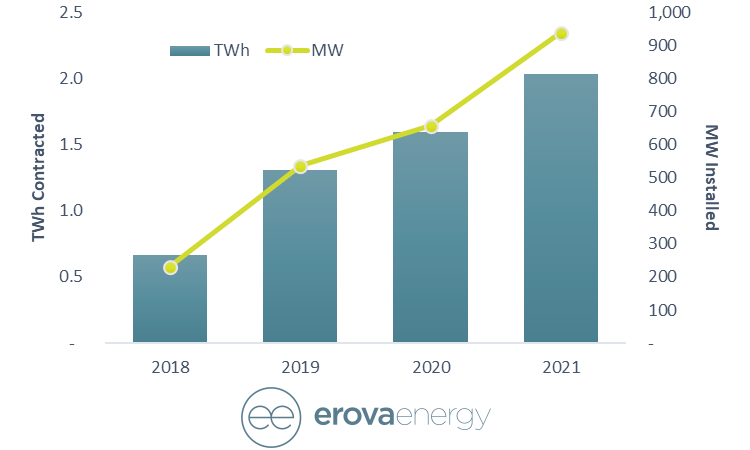
    Since inception, Erova have always looked at ways to maximise trading value, reduce risk and bring more renewables to the market. Since taking on our first renewable portfolio back in 2018 we have grown from zero MWs under managements to over 800MW with an additional 100MW in flexible generation. We aim to reach over 1GW of renewables by the end of this year with at least 20% of the portfolio coming from subsidy free assets.

    Core Markets

    Although Erova trade in 5 core markets (Ireland, UK, Netherlands, France and Germany) and as we currently look to enter new markets, more on that soon, we really focus our asset backed trading services in Ireland and the UK.

    In Ireland, our home ground, we have seen continued interest in our balancing service contracts. Providing a match against the REFIT market reference price and soon to be RESS market reference price.

    For the UK, we have continued to develop our PPA structures and continue to provide fully tailored Route-to-Market access for both renewable and flexible generation. Unlike the Irish market which continues to develop a large number of subsidy back products, the UK is moving forward with a subsidy free portfolio of projects and Erova are working with developers to maximise the value of these merchant assets especially with additional revenue streams such as the Balancing Market.


    Subsidy Free Power Purchase Agreements

    At present, ~200MW of Erova’s PPAs are from subsidy free assets which are either fully merchant or backed by a corporate PPA. We provide low cost balancing services on a long tenor, up to 15 years. This means our generators are certain of their take home price £/MWh as their balancing is fixed alongside their corporate PPA price.

    For fully merchant assets, Erova have developed their Balancing Mechanism access to allow for both large grid scale assets as well as small embedded assets to actively participate. Our AI driven price forecasts and dynamic pricing models allow for Erova to pro-actively monitor and manage the assets participation whilst remaining within the bid constraints set out in legislation (such as the TCLC).


    Bankability

    One of the key differentiators the large utilities bring to the market is their credit rating and ability to be a bankable offtaker. Over the past 3 years Erova have worked to generate a balance sheet capable of standing firm when reviewed by some of the leading project finance banks.

    More recently we’ve received an independent rating from Dun & Bradstreet of 3A, presenting the low risk nature of Erova as a counterparty.

  • Erova signs 15 year PPA with Clogheravaddy 2

    RESS 1 Wind Farm to Commence Operation under Erova PPA

    Dublin– 4th February 2022

    Erova Energy Ltd has entered into a 15-year Power Purchase Agreement with the Clogheravaddy 2 wind farm, a 10.8 MW project in Co. Donegal.

    The wind farm was successful in the country’s first RESS Auction. Under the agreement, Erova will manage the sale of the wind farm’s energy into the Irish Single Electricity Market on a 24-hour basis including all forecasting and balancing requirements. To secure the PPA Erova provide A Rated security.

    Michael Donnelly, Ireland Head of Origination, Erova Energy:
    “Erova is very proud to provide a route to market for the Clogheravaddy 2 wind farm, one of the first RESS 1 projects to connect to the grid and commence generation. Erova’s experience in trading the energy from government supported and merchant renewable projects in Ireland and abroad means that we are well placed to ensure Clogheravaddy 2 performs to the highest standard in the Irish market”.

    Erova will be providing the route to market for 14 projects who were successful in the RESS 1 auction, and it is keenly anticipating the upcoming RESS 2 auction where we will continue to offer the most competitive routes to market for any successful participants.


     -ENDS-


    About Erova Energy:

    Erova Energy is an energy trading company based in Dublin that commenced trading in the UK and Irish power markets in July 2015 and now has offices in Dublin, London and Amsterdam. Erova has unique expertise in short term traded markets with traded volumes in excess of 150 GWh/month across both proprietary and client-based positions. Erova services include interconnector trading, imbalance management, trading of renewable certificates, BESS trading, bespoke trading analytics, renewables forecasting and energy trading risk management solutions. We provide 24/7 shift trading with continuous market coverage 365 days a year. See http://erovaenergy.com/wp/


    Enquiries

    For all enquiries, please contact Michael Donnelly at michael.donnelly@erovaenery.ie 

  • Battery Optimisation

    The Process of Delivering Value

    Xie Zhang, November 2021


    The UK needs new flexibility and fast

    From 1st October 2024, Great Britain will no longer use coal to generate electricity. The energy deficit caused by the closure of coal, nuclear and gas plants can be addressed by the development of new renewable capacity. However, wind and solar power is not enough to handle the rapidly increasing flexibility deficit. This is where batteries are set to play an important role.


    Battery storage vs traditional thermal plant

    Battery storage offers unique benefits as batteries can respond extremely quickly and accurately in either direction (import or export). The National Grid ESO Control Room takes advantage of this quality and frequently uses batteries to deliver short bursts of power, typically under a 10-minute duration. This is ideal for balancing intraday swings in wind, solar and customer demand. Traditional thermal providers, including the newer, more flexible gas peaking plants, cannot do this, because of their ramp rate and minimum off times.

    Battery storage, however, has a limited lifespan before it needs to be recharged. Unlike a gas power station that could increase its power indefinitely, once the battery has discharged completely, it cannot sell any more energy. This must be recharged, either through trading or by waiting to be dispatched in the other direction.

    The good news is that 2-hour batteries are now available on the market, and our own analysis at Erova shows that the sweet spot is between 1 and 2 hours for maximum value generation.


    How does a battery make money?

    Short answer is to stack the revenues across different markets, namely Dynamic Containment and the Balancing Mechanism.

    Here is how Erova can help you get the most out of these two markets.


    Batteries in the balancing market

    The ESO Control Room makes sure that Great Britain has the essential energy it needs by making sure supply meets demand every second of every day.

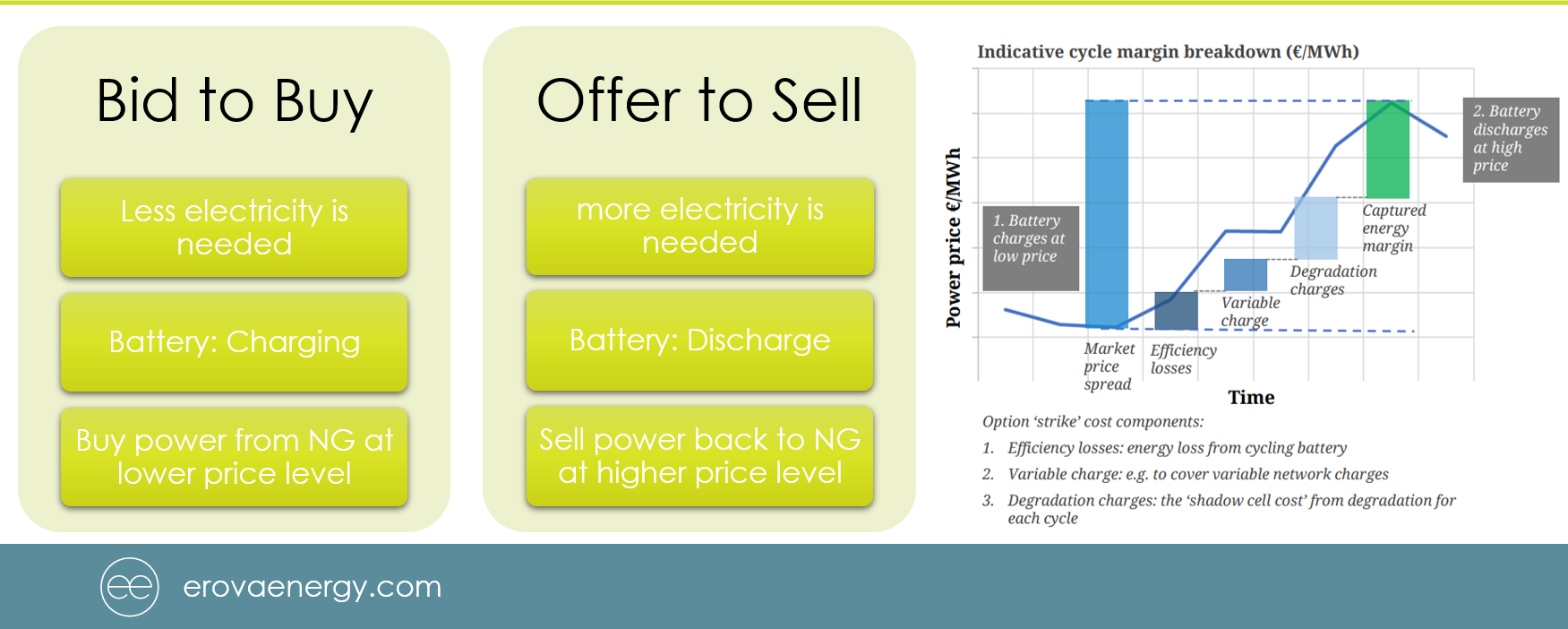
    The Balancing Mechanism is manually dispatched by the ESO Control Room – providers submit Bids (to buy from the BM) and Offers (to sell to the BM) along with the related volumes, and only deliver (and are paid) when selected.

    When more electricity is needed, National Grid accepts an offer from a provider. The battery is discharged and sends the power to the grid. If less electricity is needed, National Grid accepts a bid. The battery charges from the grid and removes electricity from the system.

    A battery is effectively an option to move power from lower price periods (charging) to higher price periods (discharging). In another word, batteries can buy power from National Grid at lower price levels and sell power back to National Grid at higher price levels. Therefore, the higher the volatility, the higher the spread between low price and high price, creating more opportunity for a battery to generate positive revenue.

    With high market volatility comes forecast risks, which need to be actively managed. Erova manages this risk using internal AI forecast models, second-by-second data monitoring and provides 24/7 trading.


    Batteries in the day-ahead market

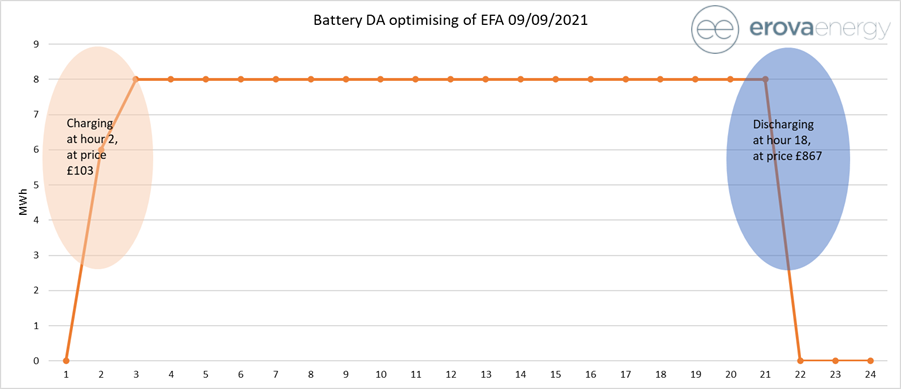
    There is another way to manage the risk and lock in revenue at day-ahead stage. The day-ahead wholesale market is relatively liquid. It comes with lower risk, but also lower volatility, which is good for creating a base layer of revenue. Utilising Erova’s systems, models and trader led optimisation, the high price period vs the low price period is straightforward to forecast.


    Batteries in the dynamic containment market

    A battery operator needs to co-optimise these wholesale and balancing revenues with other value streams, such as Dynamic Containment. Dynamic Containment is a new, fast-acting, dynamic post-fault frequency response service. It is the first of National Grid ESO’s (NGESO) new suite of frequency products, designed to stabilise grid frequency in case of large generation or consumption drop-outs.

    This response to the drop-outs needs to be available and respond quickly when called. Batteries speed and flexibility make them particularly well-suited to the task. The National Grid buys baseload power from a battery at the day-ahead stage as a preparation with previous prices running at £17/MW/hour giving a daily revenue of £408/MW (£17*24hr).

    This example shows revenue locked at £764/MW on a tight day.


    Open Energi and Erova

    Erova works alongside Open Energi on operating batteries across all value streams, we deliver full end-to-end optimisation through Trader Lead Automation. We help to decide which market is best to optimise revenue.

    For example, on a comfortable day, with low day-ahead auction prices, a battery should stay in a Dynamic Containment contract and get paid at £408/MW as main revenue. This allows for Balancing Mechanism bids (to charge), while stacking some Balancing Mechanism revenue when called.

    On a tight day, when the day-ahead auction is high enough, a battery should withdraw from a Dynamic Containment contract and move to day-ahead trading, getting paid over £408/MW along with the addition of intra-day and Balancing Mechanism participation on top.


    Future opportunity

    The latest developments from the National Grid ESO changes the Dynamic Containment contract from 24 hours to EFA Blocks since 15th September. We now see different clearing prices at varying EFA periods. This gives us more accurate market price signals, which increases market participation and, as the market develops and grows, increases liquidity.

    Erova has been co-optimising across Dynamic Containment and the Balancing Mechanism for some time and can be seen on external leader boards as delivering maximum value across all providers. Going forward our future optimisation process will now include more dynamic participation across DC + DAH + BM with Erova being one of the few Battery aggregators with both N2EX and EPEX market access for multi-DAH price optimisations.


    Click here to learn more about Erova’s Storage Optimisation Services or contact one of the Origination team.


  • Corporate PPAs and RESS

    Corporate PPAs and RESS

    Reverse RESS Auctions

    Kim Scullion, January 2021


    Overview

    Ireland has decided that the most efficient and least expensive way to achieve our Renewable Energy targets is to hold a number of auctions now known as the RESS auction.  Within this process the least expensive renewable projects will be successful whilst the most expensive will fall away or look for alternative merchant structures.

    Q: Should RESS auctions therefore not be for the full volume required to meet Ireland’s renewable energy target as they are designed to be the most efficient and cost-effective way of meeting these targets?

    Or put another way:

    Q: Is the RESS auction not the most efficient way for both corporates and generators to also meet the 15% renewable target expected to be met by Corporate PPAs? (“CPPA”)

    Corporates want to source their power from renewable sources, but it needs to be made easier for them to do this. They need to be incentivised and encouraged to participate in Ireland’s existing mechanisms that we are using to build out the renewable energy we require.


    Reverse auction for corporates

    Any projects which are ready to be built will bid into the RESS auction and the most expensive projects will not be successful.

    Q: Does this then not imply that the 15% that corporates are expected to contract with will be more expensive projects than the RESS projects?
    Q: Are corporates likely to sign a PPA for renewable generation that is more expensive than PSO generation?
    Q: Could corporates be encouraged to enter the auctions (in an opposite direction to the generators) by allowing them to take the cheapest new renewable generation to meet their demand?

    Corporates could bid their strike price offer into the auction (they would then essentially take up the least expensive volume first). Their contract could then be with the PSO so there is no counterparty risk for the generator or the corporate. If successful their Reverse RESS CFD would hedge some of the PSO exposure to the strike prices and thus reduce the volume of Feed in Premium (FIP) covered by the RESS contracts (so if there was 15% demand from corporates and they took 15% of the auction, RESS would only be supporting the remaining 85% as is expected, if corporates take up more it reduces the support required from the PSO).


    RESS support paid directly to the generator

    Reverse auctions would be another reason that a generator should not be required to enter into a PPA with a licenced supplier for RESS. Support should go directly to the generator. The generator could then have a CFD with RESS (PSO) for the RESS Strike Price and the corporate could have a (corresponding) Reverse RESS CFD with the PSO.

    There is no reason in the SEM market why a RESS generator should have to enter into a PPA with a licenced supplier to obtain RESS support. A generator can register directly in the SEM (it does not need a supplier to access the market). If it has a RESS CFD then it will obtain the RESS Strike Price less the DAM Price. To get the DAM Price it could enter into a balancing contract with a trader like Erova.

    A corporate would then be free to choose its supplier in the market and maintain the ability to change suppliers in the future (for its onsite demand) as it is free to do so now. If a generator receives the PSO support directly, you then will not have two different suppliers, i.e., one holding a PPA with the RESS generator and a different supplier supplying the corporate’s (corporate who has the Reverse RESS CFD) onsite demand.

    The SEM is designed that all generation must sell into the market and all demand has to buy from the market. So even under the current design where a RESS 1 generator has to enter into a PPA with a licensed supplier, the supplier has to “sell” this generation into the market and then buy it back if it needs these MWhs to meet its demand i.e., the RESS generator’s MWhs are not netted from the supplier’s (supplier who holds the RESS PPA) physical demand.

    There is no reason why a RESS generator should have to enter into a PPA with a licensed supplier in order to get RESS support.


    Paying for renewable generation through a PSO Levy

    If corporates want to base themselves in Ireland and do not contract directly with renewable generation or through a Reverse RESS CFD scheme they will be subject to the PSO levy like all customers in Ireland.

    If corporates want to say they are 100% powered by new renewable generation, they could contract for this through a Reverse RESS CFD. Potentially, they could then be given an exemption from paying the PSO levy for the volume they have a Reverse RESS CFD in place for.

    This saving could then be weighed up when choosing to bid into the Reverse RESS CFD auction (i.e., forecast of the cost of the PSO levy on their demand for the next 15 years vs fixing a Reverse RESS CFD which exempts them from this cost, as well as hedges the variable cost of their electricity supply bill).

    A: Corporates that have a Reverse RESS CFD for some of their demand volume could get an exemption from paying the PSO levy on this volume.


    Reverse auction for anyone

    Technically anyone could be allowed to bid in on the reverse side of the RESS auction (subject to certain collateral or qualification requirements). If you would like to buy additional renewable generation by entering into a Reverse RESS CFD you could.

    This could create demand from corporates or even a secondary RESS market. So, for example, a trader or supplier could buy a Reverse RESS CFD and sell on to a corporate.

    Demand would still have to come from a corporate as they may only want this type of contract if they knew they would have to pay a higher PSO levy to cover 100% of their generation or a higher levy if they do not secure renewable generation themselves through a Reverse RESS CFD.

    Reverse auctions could be run at the same time as the RESS auction and bids to buy could be matched with offers to sell or they could be run separately to RESS auctions, after the event.

    Reverse RESS CFDs could also be for different terms. Just because the RESS contract is for 15 years does not mean the Reverse RESS CFD would have to be for the same length of time.


    Potential barriers that may delay uptake of CPPAs

    Some of the barriers for the delay in uptake of CPPAs include price, term, size, and traceability.

    Price

    In Ireland, a CPPA with a renewable generator is likely to cost in the range of €55/MWh and €70/MWh depending on the technology and competitive nature of the project. This compares to wholesale prices for “brown power” currently in the €40’s/MWh.

    A: A RESS auction for Ireland’s full renewable target (i.e., including the expected 15% from corporate demand) would ensure the corporates pay the cheapest price for new renewable generation.


    Term

    A new renewable generator will need a fixed price for a long term, so probably 8, 10 or even 15 years in order to satisfy their lender’s requirements for the project debt. Most small or medium sized corporates will not have board approval to sign any type of contract past 5 years.

    Also, many corporates will not want to fix a price for a long term if they think their competitors are not fixing a price too. This is because, should prices subsequently fall and their competitors who did not fix were then paying less for their power than themselves this would then allow their competitors to decrease the price they were charging their customers (corporates pass through their costs of power to their customers). A year or two of this could put the corporate that had fixed a higher power price out of business.  (Although this could be offset by the fact that any corporates picking up cheaper wholesale power could be paying a higher PSO levy if they have not secured a long term Reverse RESS CFD).

    Although some large corporates will be in a position to enter into long term deals to enable a renewable project to be financed this will be limited to a small number of very large players.

    A: Reverse auctions can be for any term with any volume contracted to a corporate contributing to reducing the exposure to Feed in Premium (FIP) on the other side of the RESS auctions (i.e., reducing the PSO).


    Size

    Renewable energy projects vary in size, but most commercial projects are above 5MW. A project this size produces a lot of electricity over the year, the number of individual corporates of this size are limited. Aggregation of corporates would be great but the ease and speed at which this could happen to get a project over the line is not to be underestimated.

    A: Reverse auctions could be for any volume. RESS generators will have their RESS contract for their full volume for 15 years but corporates could secure a Reverse RESS CFD for any volume for any term. The Reverse CFDs could be with the PSO and not the counterparty.


    Traceability

    As the SEM is not a physical market any corporate who now signs a CPPA with a generator is still not “physically” getting the generation from this project. All generation must be sold into the SEM and all demand must be purchased form it. Therefore, there is no reason why a corporate signing a Reverse RESS CFD with the PSO would prove anything less in terms of their demand being met with new renewable generation than a CPPA does now in SEM.


    Conclusion

    It is widely publicized that data centres will increase Irelands demand for power over the next few years. This increase in power demand increases our RESS target and increases the risk that we will miss our targets for meeting a percentage of this higher demand figure with renewable energy.

    Large energy users need to be encouraged to source their power from renewable power. Or at least some of the barriers for not entering into a CPPA on both sides (generator and corporate) need to be addressed by the government if they are relying on a portion of their RESS target being met by CPPAs.

    If CPPAs do not deliver as expected, Ireland will not meet their targets and will be subject to EU fines. Corporates will not pay for these fines, Ireland will.

    A government backed and run Reverse RESS auction could help reduce the barriers to entry for all size corporates, reduce the country’s PSO burden and make sure Ireland meets its RESS targets.

    To discuss further please contact trading@erovaenergy.ie

  • Erova Energy approved by Elexon as a Virtual Lead Party

    Generators can benefit from wider access to Erova’s Balancing Mechanism service


    LONDON – 10th December 2020


    Erova Energy, the dynamic energy trading provider, has been approved by Elexon as a Virtual Lead Party. The new agreement will see Erova providing wider access to the Balancing Mechanism for its generators through its Erova.io platform.

    The license will enable more generators to sign up to the energy trading platform, which help to increase the flexibility of the National Grid, ensuring electricity demand is balanced, especially during peak usage times or times of low generation. It will also support the deployment of more renewables on the Grid, delivering long term sustainability benefits.

    Erova.io is a Virtual Power Plant (VPP) platform that enables generators to manage the aggregation, forecasting and trading position across their entire asset portfolio. The Erova trading team brings to market extensive experience in managing large gas fired power plants within the Balancing Mechanism.

    Following the recent Elexon approval, Erova can now provide Balancing Mechanism access to a wider range of embedded and supplier registered assets. It will also enable Erova to create additional revenue stream to deliver subside free onshore wind or solar.

    “The energy market is at a pivot point as generators strive for new and innovative ways to manage their assets,” said Nick Williams, Director of Origination at Erova. “The Covid-19 pandemic has created new demands in electricity usage. Our partnership with Elexon will enable us to provide power generators with a more agile and flexible model to meet changing market expectations.”

    Erova currently manages over 700MW of renewable generation across a range of Route to Market structures including Power Purchase Agreements in Ireland and the UK. During the past 12 months Erova has continued to develop their trading platform to include Battery Storage and Gas Peaking plants.

    The Virtual Lead Party role was created as part of a Wider Access initiative by both National Grid ESO and Elexon to enable a wider participation of assets and customers into the Balancing Mechanism. By increasing the availability to more assets National Grid ESO aims to develop a more flexible system especially as more intermittent generation joins the UK fuel mix and with recent fluctuations in electricity demands following the Covid-19 crisis.


     -ENDS-


    About Erova Energy:

    Erova was established in 2015 and has grown rapidly in both financial strength and products offered to the market. Having created a bespoke trading platform with 24/7/365 operation capabilities and trading across the full energy spectrum (power, gas and certificates), Erova has been able to offer bespoke route -to-market agreements in the UK and Ireland. A-rated Mitsui & Co invested in the company in March 2018. See http://erovaenergy.com/wp/


    Enquiries

    For all enquiries, please contact Nick Williams on +44 (0)7733 184654 or email nick.williams@erovaenergy.ie